Sunday, October 08, 2006

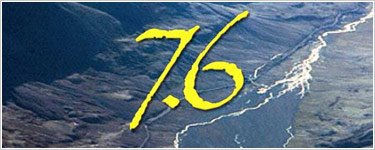
"7.6" film


Last term I was involved with earthquake relief and awareness on my campus. Praise to God, we did quite well. We raised funds, had a really successful awareness dinner, and did various things throughout second semester. It was also good because we worked with other groups as well.
I think next time, if I'm going to do something like that again, I'm going to work on getting a core group of people to help me. Also, I should have focused on doing only 2 or 3 big events. Instead we had about 5 or 6. I learned to concentrate my efforts. Nevertheless it was overwhelmingly a good and positive experience.

I basically didn't blog while I was in NYC. Well, through amusing circumstances, I got involved with a bunch of people who formed an NGO called Foundation of Young Intellectuals. Basically their film "7.6" is about the impact the earthquake that happened in South Asia, exactly a year ago, affected children. They filmed kids painting about their experiences. I really liked the idea of the film, and so I signed on. As an intern, of course.

They are premiering it today at the South Asian International Film Festival. Of course I couldn't be there. I wish these guys all the best on this project and future ones. Honestly they were a really good bunch of people to work with and get to know; I was only with them for a few weeks but it was really great. I got to experience what real independent New York filmmaking is like, and how much these guys had to work - literally around the clock.

Thank God for Alison Weir

From counterpunch.org:

October 6, 2006

Gunning Down Itemad Ismail Abu Mo'ammar

Just Another Mother Murdered

By ALISON WEIR

Almost no one bothered to report it. A search of the nation's largest newspapers turned up nothing in USA Today, the Boston Globe, Boston Herald, Chicago Sun-Times, Atlanta Journal-Constitution, San Francisco Chronicle, Seattle Times, St. Louis Post-Dispatch, Houston Chronicle, Tampa Tribune, etc.

There was nothing on CBS, NBC, ABC, CNN, PBS, NPR, Fox News. Nothing.

The LA Times, the Washington Post, the New York Times, and Associated Press each had one sentence, at most, telling about her. All three left out the details, the LA Times had her age significantly off, and the Washington Post reported that she had been killed by an Israeli tank shell.

It hadn't been a tank shell that had killer her, according to witnesses. It had been bullets, multiple ones, fired up close.

Neighbors report that Israeli soldiers had been beating her husband because he wasn't answering their questions. Foolishly or valiantly, how is one to say, the 35-year-old woman had interfered. She tried to explain that her husband was deaf, screamed at the soldiers that her husband couldn't hear them and attempted to stop them from hitting him. So they shot her. Several times.

Her name was Itemad Ismail Abu Mo'ammar.

She didn't die, though. That took longer. It required her life to flow out of her in the form of blood for several hours, as Israeli soldiers refused to allow an ambulance to transport her to help. Her husband and children could do nothing to save her.

Finally, after approximately five hours, an ambulance was allowed to take her to a hospital, where physicians were able to render one service: pronounce her dead, a few days before the commencement of Ramadan, a season of family gatherings much like the Christmas season for Americans. She left 11 children. None of this was in the Washington Post story, which had reported her death in one half of one sentence.

Her husband's brother, who lived in the same house, was also killed. He was a 28-year-old farmer.

Why did this all happen? The family lived behind a resistance fighter wanted by Israel. They were simply "collateral damage" in a failed Israeli assassination/kidnapping operation.

All together, five Palestinians were killed that day. The other three were young shepherds killed in another area, two 15 years old and one 14, who seem to have simply been in the wrong place at the wrong time. Gaza.

None of this was reported in most of America's news media, and so the American public never learned about a mother bleeding to death in front of her children, or young shepherds being blown to pieces. Apparently, it just wasn't newsworthy.

A Case Study of "Good" News Coverage

The Washington Post at least mentioned these deaths, so perhaps those who care about journalistic standards should laud the Post for its coverage.

And yet, the Post in its short report got so much so wrong.

In addition to misreporting Itemad's cause of death and omitting critical facts, the Post's story portrayed the entire context incorrectly, telling readers that these five deaths had broken a period of "relative calm."

The fact is that while it was true that in the previous six months not a single Israeli child had been killed by Palestinians, during this period Israelis had killed 75 Palestinian young people, including an 8-month-old and several three-year-olds.

I phoned the Post and spoke to a foreign editor about the need to run a correction, providing information on Itemad's murder. The editor said that she would pass this on to their correspondent (who is based in Israel), but explained that it was "impossible for him to go to Gaza." When I disagreed, she amended the "impossible" to "very difficult." She neglected to mention that the Post has access to stringers in Gaza available to check out any incident the editors deem important.

Next, I wrote a letter to the paper containing the above information. Happily, the Post letters department apparently checked it out and decided it was a good letter. They sent an email informing me that they were considering my letter for publication and needed to confirm that I was the one who had written it, and that I had not sent the information elsewhere.

I replied in the affirmative, we exchanged a few more messages, and everything appeared on target. Normally, when publications contact you in this way, your letter is published shortly thereafter. I waited in anticipation. And waited.

It is now almost two weeks after their report, and I have just been informed that the paper has decided not to print my letter. The Post has apparently determined that there is no need to run a correction.

I think I understand.

Although the Washington Post's statement of principles proclaims, "This newspaper is pledged to minimize the number of errors we make and to correct those that occur... Accuracy is our goal; candor is our defense," the American Society of Newspaper Editors clarifies these ethical requirements: corrections need only be printed when the error of commission or omission is "significant."

And, after all, these were only Palestinians, and it was just another mother dead.

Alison Weir is Executive Editor of If Americans Knew, which has produced in-depth studies and illustrative videos on American news coverage of Israel-Palestine.
Saturday, September 30, 2006

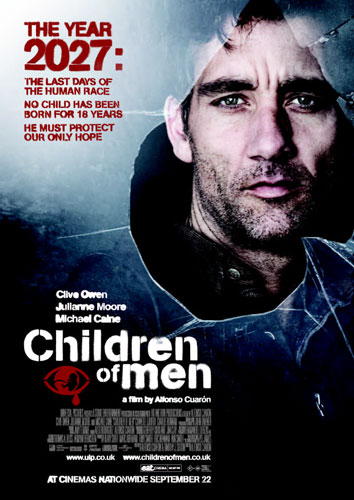
Children of Men


From timeout.com - you've gotta see this film. Comes out Christmas Day in the States.

Venice diary - 'Children of Men' review
Dave Calhoun looks at Alfonso Cuaron's gripping adaptation of the P D James' sci-fi novel.
Dave Calhoun | Sep 4 2006

Clive Owen and Julianne Moore in 'Children of Men'
It's fitting that Alfonso Cuaron's new film, 'Children of Men' should have its world premiere in Venice in the same week that a major celebration of new Mexican cinema opens at London's National Film Theatre. Cuaron's latest film - an adaptation of P D James' sci-fi novel - is testament to the growing influence of Mexico on current world cinema. Together with fellow director Alejandro Gonzalaz Inarritu ('21 Grams', 'Babel'), screenwriter Guillermo Arriega ('The Three Burials of Melquiades Estrada') and actor Gael Garcia Bernal, Cuaron is both revitalising the domestic Mexican industry with films such as 'Y Tu Mama Tambien' and injecting new spirit into English-language film with Hollywood-produced fare such as this latest movie.

Cuaron's first film since 'Harry Potter and the Prisoner of Azkaban' doesn't disappoint. 'Children of Men' is a clever vision of London in 2027 - an unhappy, paranoid and claustrophobic time when Britain is the only surviving nation in the world and a fertility crisis means that no new babies have been born for eighteen years. A rebel outfit of guerilla refugees (or 'fugees') known as The Fish loom threateningly in the background and the Department of Homeland Security have been ordered to arrest all illegal immigrants, cage them and propel them to the fortified compound of Bexhill-on-Sea. Never has the familliar name of a Kentish seaside town sounded so sinister. It hardly needs saying the focus on migrancy has an uneasy potency.

It's a film which easily could have been ridiculous. In Cuaron's hands, it emerges as quite some achievement, both technically (look out for the one-shot take that graces a battle scene late on) and dramatically (the script and performances are tight and credible; even Michael Caine is amusing as a cardigan-wearing, pot-smoking, Roots Manuva-listening old sage). Considering that P D James' plot is so far-fetched, it's all the more impressive that Cuaron's unhappy vision of the future is convincing. Its his boldness that makes it work. He doesn't bother with easy explanations or back story; he plunges straight into the action, shooting in an unfussy, in-your-face style and employing only the most necessary of special effects.

His prognosis of the future is gripping from the off; civil servant Theo (Clive Owen) is buying a coffee in the Square Mile when he notices a news report on TV. The newreader (a face recognisbale from television today) announces that the world's youngest person, 18-year-old Diego has died in a street brawl. It's major news. The public weep. Theo asks for a day off to recover. And it's no leap of the imagnation to connect the reaction to Diego's demise with the outpouring that greeted the death of another celebrity with a similar-sounding name back in 1997. When Owen finds himself unwitting guardian to the only pregant woman on earth, a Messianic tone infects the film, but Cuaron wisely backs off from stressing the Biblical overtones too much; at one point he pointedly pulls the needle off a choral number on the soundtrack in order to return to violent conflict.

One of the film's more striking features is that London in 2027 doesn't look so different from today's city. The red buses are more old and tatty, which contrasts nicely which the usual chrome-and-cream furnishings of the future. It still rains incessantly and the city's buildings remain grey - only many are now adorned with moving-image advertising. It's the creepy familiarlity which makes Cuaron's film so gripping and often terrifying.

Thursday, September 28, 2006

Stop picking on us

Today I went to a screening of a bunch of short films that were sponsored by the film council. One of them was made by an Asian Muslim, about a young Muslim lad, who chooses cricket over terrorism. Some brothers in his local mosque get him to come to a meeting, where they're watching a video of an old uncle mullah ranting. Someone is coming to meet this brother because they want his "help", but he leaves. Instead of going down that path, he plays cricket and is spotted by a scout.

I respect this filmmaker for getting his views out. He said he got a lot of positive feedback on it. I wonder if anyone ever told him that what he's done is further establish the stereotype that Muslims in the UK have today - this film is clearly related to the bombings of 7th July last year.

What those bombings have resulted in is the massive Muslim community being targeted by the government more than ever before. People like Tony Blair and John Reid tell Muslims to watch out for any suspicious activity, to spy on their fellow Muslims, to rat on them if anything seems funny. Essentiallly the film mentioned above does the same, by making audiences think that yes, in your average mosque you will find brothers who want to recruit innocents to blow up people.

Don't you think its a bit funny that someone like John Reid can show up in the east end, a heavily populated Muslim area, tell people to spy on their kids, to not be too religious for that can lead to fanaticism, and then right away get a slew of reporters asking him questions? I mean I haven't even been here two weeks, but before coming here I knew that this stuff was going on in Britain, of Muslims being targeted. And after 10th of August, I think most if not all of the arrested were from the east end, particularly Walthamstow.

Once again those being arrested are not being put on trial but simply being detained, just like Muslims in America. The difference here is that while the Patriot Act stuff has died down in America, Britain is now stepping up in its efforts of monitoring and fingering Muslims. Why are we being targeted? Muslims here have the huge problem of ghettoization, drugs, crime, poverty. Just because there are many folks around here with beards and thawbs, nikabs and jilbaabs, doesn't mean they're dangerous. It is blatant institutional discrimination, and it starts from the top with Tony Blair. Its disgusting to think that these government officials tell Muslims to spy on their own, to watch out from terrorism, while they wage war against Muslim countries and kill 100,000s of innocent people.

Disgusting.

I don't want your socialist paper

Why does everyone need a label?

Just because I come to your events and protests, that doesn't mean that you can assume I'm just like you or have the same viewpoint on everything. Please, I don't want to join your socialist organization, stop bugging me about it. I don't want your paper, because I follow the news already and don't need your slant on it.

You know I've noticed the same things here that I did in New York. I've met many activists who are socialists. They're cool but a few times, certain people keep bugging me about socialism. I tell them I'm not interested for personal reasons, but sometimes that answer isn't good enough.

Am I a leftist? Am I a liberal? If you asked me my viewpoints on everything you and I would both figure out, that I'm not as far left on everything as I appear to be. Why do I have to labeled? A leftist, or a liberal, or a socialist? Why must we pick sides? Can't I criticize the left? The left isn't right on everything man. For instance I feel a pressure, which I felt today, that we all must be labeled and be united against everything else. We are always in the right, and everyone else is wrong. Oh sure we'll debate and hear their arguments, but we're right because we're on the right side.

I don't want to be labeled. I'm not a leftist, or a liberal, and I'm certainly not a socialist. But that doesn't mean I'm a capitalist, not by far. But I am a human being, who just cares about other human beings. Why does everything have to be labeled? And as this movement or that movement? Its all one struggle isn't it? Does that struggle need a name also? Does it need to be called a coalition? Or even equality, justice, or freedom? How about just a fight for humanity? Not for leftism or socialism or the anti-war movement or the solidarity movement - just, humanity.